
















A free accessibility statement template for the German BFSG law, with legal background, practical tips and sample wording to help avoid costly warning letters.
| Period: | since 2023, continuous development |
| Budget: | Six-figure (BMFTR (formerly BMAS) funding Grant 05D23CJ1) |
| Team: | 5 people |
| Industry: | Materials Research, Particle Physics, Large Research Facilities |
| Area of Application: | Neutron Reflectometry, X-ray/Neutron Scattering, Plasma Diagnostics |







In materials research at large research facilities like Forschungszentrum Jülich, DESY, or the European XFEL, enormous amounts of data are generated daily from high-precision measurements. A fundamental problem is the so-called phase problem. In X-ray and neutron scattering, essential phase information is lost in the detector. The result is an ambiguous interpretability of the measurement data, comparable to the square root of 4, which can be both +2 and -2.
Classical analysis methods are based on time-consuming iterative optimization procedures. For modern experiments with thousands of measurements and the desire for real-time feedback during measurement, this is not practical. The VIPR consortium project funded by the Federal Ministry of Education and Research aims to fundamentally solve this challenge through the use of invertible neural networks.
Helm & Walter was accepted as an industry partner for framework design and development into the consortium, which collaborates with six leading research institutions as well as international partners such as CERN and Berkeley Lab. The challenge was to create a framework that offers both the complexity and power for diverse inverse problems while keeping the barrier to entry for researchers without a computer science background as low as possible.
The goal was to develop a flexible software framework for data-driven solutions of inverse problems based on invertible neural networks. The framework should enable researchers at large research facilities to perform user-friendly data analysis as a cloud application. Near real-time preliminary analysis of collected (sensor) data during ongoing experiments is the primary objective that the framework should meet in practice. This should make the expensive deployment and limited resources in these research areas significantly more effective and efficient.
In neutron reflectometry, central material properties must be reconstructed from noisy reflectivity measurement data. These include, for example, the layer thickness of thin films in the range of a few to hundreds of Angstroms, the roughness of interfaces, density profiles in the form of scattering length density, and magnetic properties in polarized measurements.
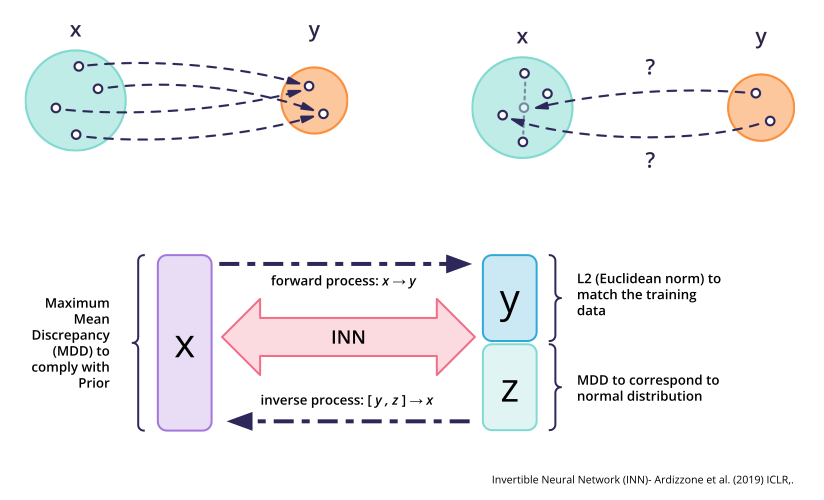
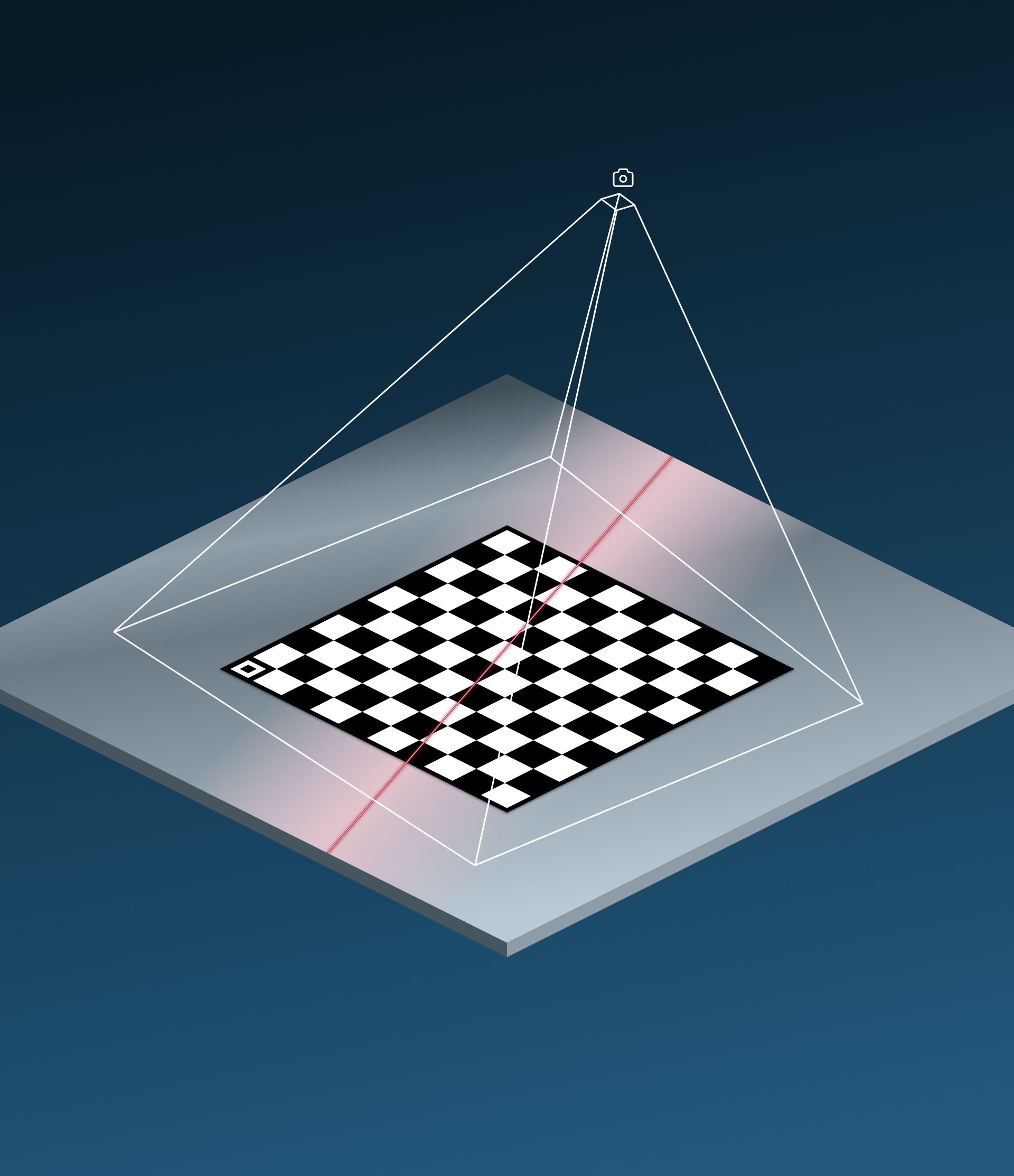
Schematic representation of an inverse problem. While the forward problem uniquely leads from input to output, in inverse problems multiple inputs can lead to the same output.
Classical analysis is time-intensive, often occurring hours or even days after the experiment, and frequently required additional manual adjustments by experts. For real-time feedback during experiments, automated adjustment of measurement parameters, high-throughput analyses with thousands of datasets, or in-situ process control, this is simply not suitable.
Added to this is the fundamental ambiguity of inverse problems. Different material configurations can generate identical measurement signals. Without deep expert knowledge and physical understanding, reliable interpretation is nearly impossible.
The greatest challenge for a software framework in general often lies in the heterogeneity of use cases. VIPR - as a software framework for AI workflows - should be usable not only for neutron reflectometry, but also for GIWAXS analyses, ptychography, plasma diagnostics in coating processes, and potentially even for spectroscopy, particle physics, and many other application areas.
The target groups are initially researchers from physics and materials science, and NOT computer scientists. This user group wants to solve their specific, sometimes highly specialized problems with manageable adjustments. This creates a direct tension with the complexity and power that a universal software framework should offer.
The basic idea behind the VIPR framework is to easily replace, adapt, or extend individual components in a workflow. The framework is based on a modular concept with multiple abstraction levels, designed to offer both flexibility for experts and easy usability for beginners.
Every execution step in the workflow can be made visible and loggable through hooks. Hooks are called before and after each step execution and enable debugging outputs and logs, visualization generation, or intermediate result storage without intervention in the core logic.
With filters, input and output values can be specifically modified before each processing step. This enables normalization, data augmentation, or transformation between different representations.
Plugins are the central extension concept. They enable not only the integration of corresponding hooks and filters for basic steps, but also the complete replacement of workflow steps with custom logic. A plugin can bring its own pre-trained AI models, implement domain-specific data pre- and post-processing, or even introduce entirely new, more complex workflow types.
Unlike classical neural networks, Invertible Neural Networks learn a bidirectional mapping. They can both compute from material parameters to measurement data, thus solving the forward problem, and conversely infer the underlying material parameters from the measurement signal.
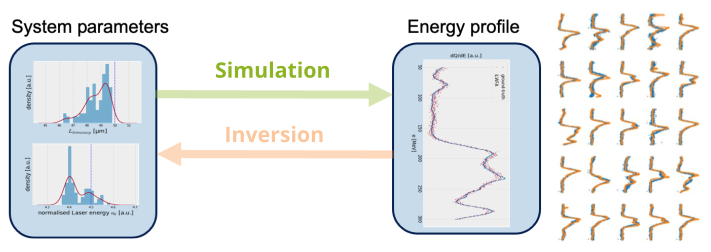
Functional principle of invertible neural networks: Bidirectional mapping between material parameters and measurement data enables solving both forward and inverse problems.
The decisive advantage is that the analysis occurs in a single forward pass through the network. Time-consuming iterative optimization is eliminated. Moreover, INNs can predict not only individual parameter sets, but complete posterior probability distributions. This quantifies the uncertainty of reconstruction and makes multiple possible solutions of an ambiguous inverse problem explicitly visible.
The results of INN prediction can also be used as initial conditions for classical local fitting, which further increases robustness and enables dramatic accelerations of analysis time.
The VIPR framework enables the reconstruction of probability distributions for inverse problems. The following visualizations show typical analysis results from neutron reflectometry and other applications, where invertible neural networks transform ambiguous measurement data into interpretable parameter distributions.
Inverse problems by definition often have multiple valid solutions. The deployed INNs quantify this uncertainty by predicting complete probability distributions instead of individual values. At the same time, it had to be ensured that the predicted parameters are physically meaningful. For this purpose, special constraints and physics-informed loss functions were implemented that enforce physical laws during training.
The fundamental tension between the power of a universal software framework and simplicity for the user runs through all design decisions. The solution lies in several parallel access paths. Researchers who need quick results can work through the web interface with preconfigured workflows. Those who want to dive deeper can work through the config system and recombine existing components. For highly specialized applications, the full plugin mechanism is available.
It is crucial that high-quality example implementations and documentation are provided. These then show best practices, demonstrate the power of the framework, and simultaneously serve as starting points and blueprints for custom adaptations. This minimizes the barrier to entry for solving concrete problems without unnecessarily restricting flexibility.

Conception and implementation of the modular VIPR architecture with plugin system, extension mechanism, hooks, filters, handlers and controllers. Development of core functionalities in Python with PyTorch as ML backend. Integration of FREIA for invertible network architectures and Reflectorch for physical simulations in reflectometry. The architecture enables researchers to make adaptations at various abstraction levels, from simple configuration to complete custom implementation.

Development of concrete extensions for various use cases. The Reflectometry Plugin for example enables analysis of X-ray and neutron reflectometry data. The cINN Plugin implements conditional Invertible Neural Networks for regression problems with uncertainty quantification. Comprehensive example implementations demonstrate best practices and serve as starting points for custom adaptations by researchers. These reference projects show the framework's power while maintaining a low barrier to entry.

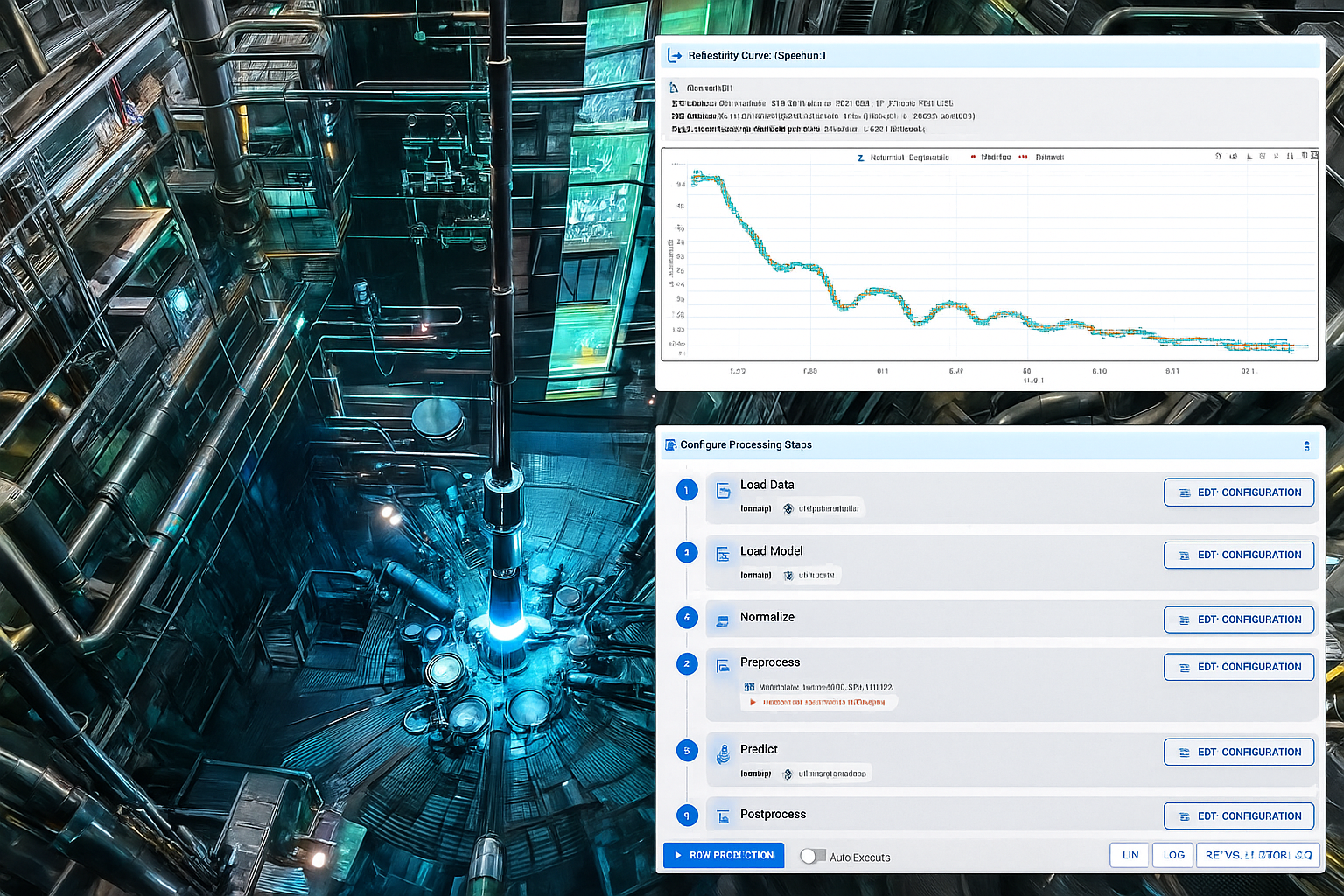
Development of a web-based analysis platform with Vue.js frontend and FastAPI backend. Visual pipeline configuration enables researchers without programming knowledge to create complex analysis workflows. Visualization of analysis results with interactive plots shows ad-hoc intermediate results and enables immediate plausibility checks.
Containerization of all components with Docker for reproducible environments. Kubernetes-based orchestration for scalable deployments from local development to productive cloud operation. Development of Helm Charts for flexible installation in various environments of partner institutions. CI/CD pipelines for automated testing and deployments ensure quality and rapid iteration.

Close support of scientists at partner institutions through regular coordination and joint development sessions. Conducting workshops and training for framework usage. Creation of technical documentation and scientific publications. Transfer between basic research and practical application by translating physical requirements into technical implementations. Coordination of requirements from various application domains and their mapping and implementation in the framework.
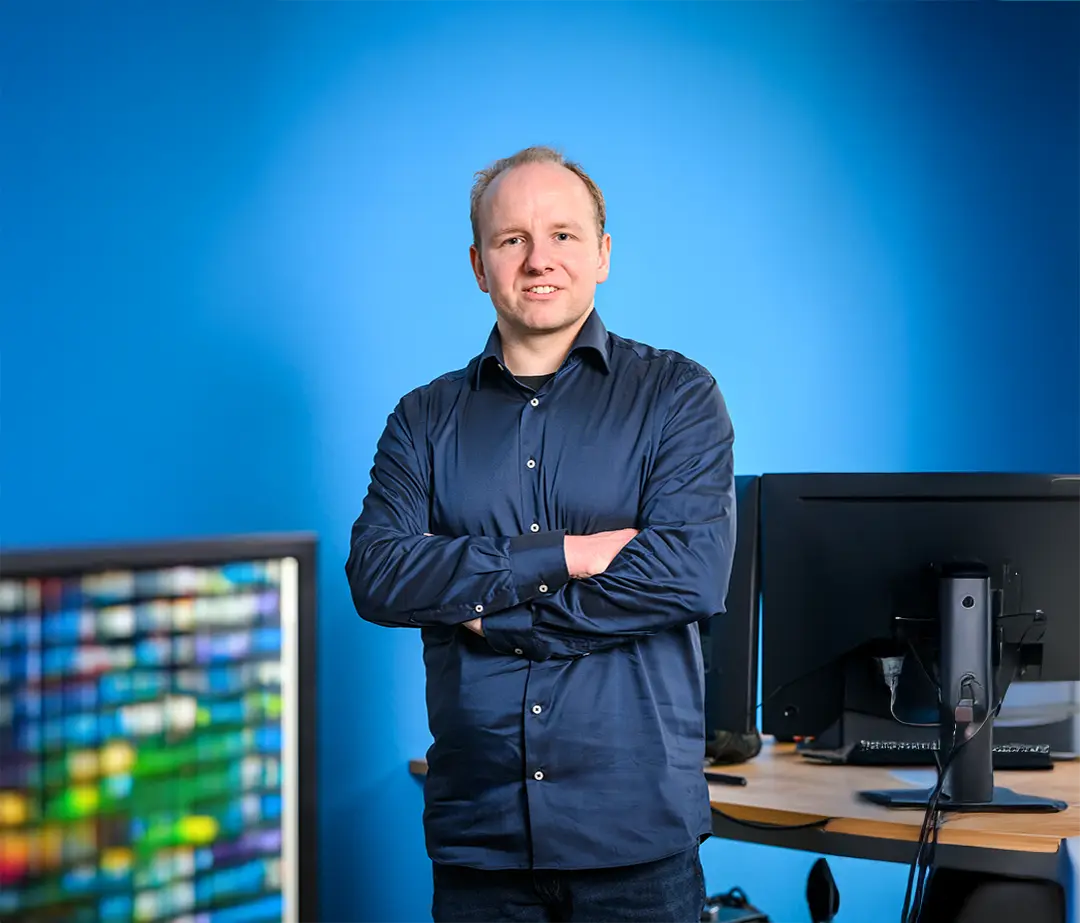
As a PhD experimental physicist, Sascha is the central figure in the practical implementation of the VIPR project. He drives framework development significantly and is responsible for many ongoing design decisions. Fundamental architectural decisions are made in exchange with the team.
Sascha closely supports scientists from partner institutions, conducts example implementations for reference projects, and coordinates researchers' concerns so that their specific requirements are reflected in the VIPR framework. His experimental physics training proves to be a decisive advantage. Sascha speaks the language of users and understands the physical backgrounds of inverse problems firsthand. This significantly reduces communication barriers and enables him to function as a bridge between abstract software architecture and concrete scientific questions.
Technically, Sascha implements the framework's core functionalities, develops domain-specific extensions like Reflectorch and cINN modules, and ensures that integration of invertible neural networks functions robustly and efficiently.
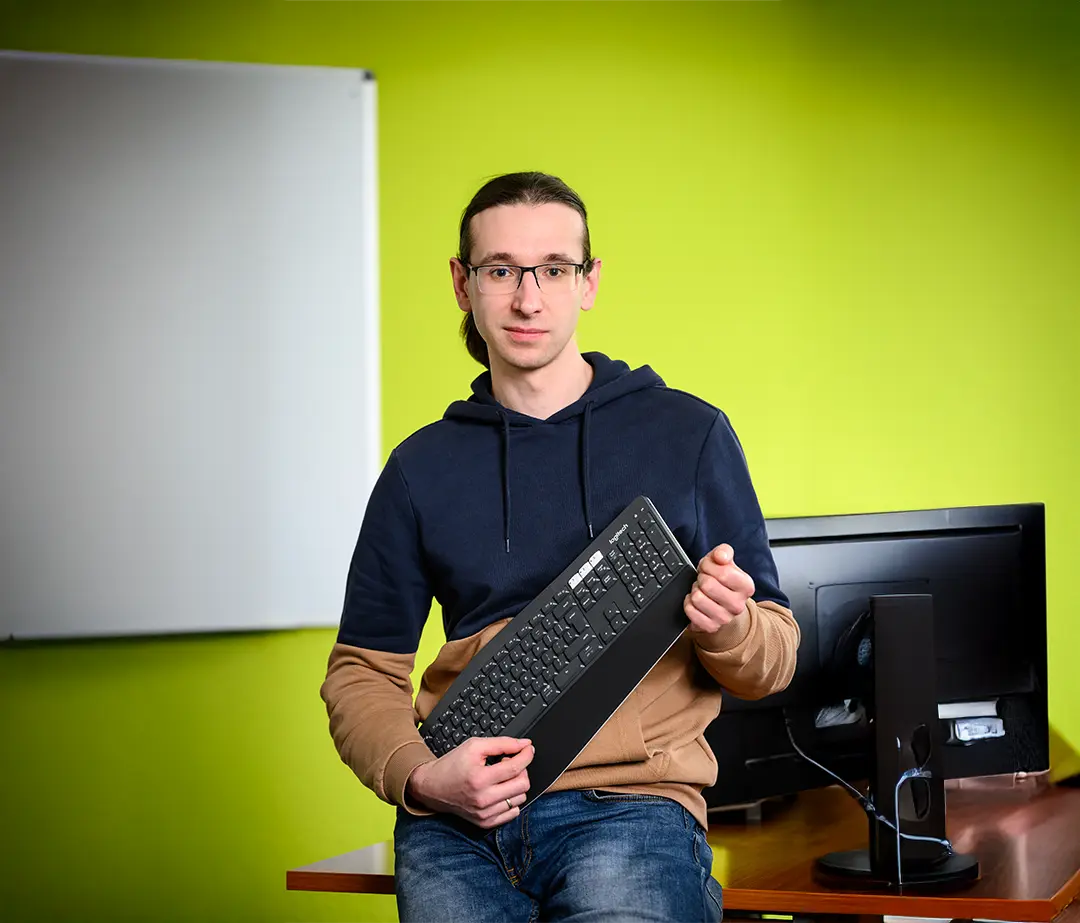
Nico bears responsibility for all AI-related aspects of the project. He decides on technologies to be deployed, model architectures, and meaningful training strategies. His expertise in AI research and particularly with invertible neural networks is essential for the project's scientific quality.
As AI Department Lead, Nico coordinates collaboration with research partners at the scientific level. He evaluates new methods from literature for their applicability to VIPR, develops problem-specific adaptations, and is responsible for publication strategy. He ensures that developed methods not only function practically but are also scientifically sound and advance the state of research.
The VIPR story begins years before the BMFTR (formerly BMAS) project. Bernd was the initial architect of a base project from which the VIPR framework then grew. He made the first software architectural decisions that still provide the foundations and set the course for the now greatly expanded framework.
The original project was also one of Helm & Walter's first intensive contact points with AI research. These experiences shaped Bernd's further career path and were a significant impulse for building the AI division Saxony.AI. As CTO and Technical Lead of the AI Department, Bernd now brings his long-standing experience in software architecture and his vision for scalable, sustainable systems to the project.
Jens is responsible for project management for VIPR on behalf of Helm & Walter. He coordinates collaboration between various stakeholders, plans milestones, and ensures the project progresses on schedule and within budget.
Furthermore, Jens provides advisory support to Sascha with his long-standing experience in software architecture. Together they make decisions that shape the project's further course and set the framework for the most flexible usability and power of the framework. These decisions must consider the tension between complexity and user-friendliness.
Robert implements the Kubernetes-based deployment infrastructure for VIPR. He develops the Helm Charts that enable flexible installation of the framework in different environments. From local development environments through dedicated servers at research institutions to scalable cloud deployments, the framework must be operational everywhere.
Robert ensures robust CI/CD pipelines that enable automated testing, container builds, and deployments. He provides advisory support to those responsible at the Helmholtz Research Community, who could become operators of a possible cloud infrastructure for the VIPR ecosystem, with his long-standing experience as DevOps and administrator.
Project leadership and coordination. Responsible for strategic direction, infrastructure, and collaboration between all partners.
Implementation and integration into data pipelines. Practical application of VIPR at neutron scattering instruments and generation of synthetic data.
Knowledge transfer and documentation. Creation of comprehensive documentation, white papers, and conducting training for the scientific community.
Data preparation and problem definition. Precise preparation of training data and definition of inverse problems for various scattering methods.
Development of invertible neural networks. Focus on feature extraction, uncertainty quantification, and improvement of INN robustness.
Quality assurance and framework design. Testing the user interface and evaluating software functionality for the community.
Funded by: Federal Ministry of Research, Technology and Space BMFTR within the ErUM project funding (Project 05D23CJ1)