











A free accessibility statement template for the German BFSG law, with legal background, practical tips and sample wording to help avoid costly warning letters.
| Period: | Development since 2021, in use since 2022, continuous development since then |
| Budget: | Six figures |
| Team: | 4 people |
| Industry: | Energy Industry, Transmission Grid |
| Area of Application: | Reconstruction planning of supra-regional power grids |
In the digitized working world, companies undergo a continuous transformation process. Proven tools and methods that have provided reliable services for years increasingly reach their limits with growing complexity and rising requirements. Many organizations face the challenge of recognizing the right time for the transition from established but limited solutions to modern, integrated systems.
The transmission system operator TransnetBW faced a similar situation, specifically the reconstruction planning department, which used various decentralized tools. What initially seemed practical led to inefficiencies, redundancies, and high manual coordination efforts as the network complexity and planning tasks increased. The need for a specialized, cloud-based solution became increasingly clear to meet the requirements of a modern transmission system operator.
Helm & Walter IT-Solutions GmbH was commissioned to develop a web application for TransnetBW's reconstruction planning. The concept was developed under the leadership of the Dresden engineering office GRIDSIDE Energy Consult, while the technical implementation was entirely the responsibility of Helm & Walter.
The goal was to significantly optimize the entire workflow of reconstruction planning through improved overview of power grid equipment (power lines and routes), extended functionalities, and full or partial automation. A special focus was on improving the circuit diagram, which is now more clearly designed and meaningfully interconnects the various elements.
Fundamental to the development was the creation of a data model that maps the complex relationships between the above-mentioned technical terms, thus providing a solid basis for reconstruction planning work.
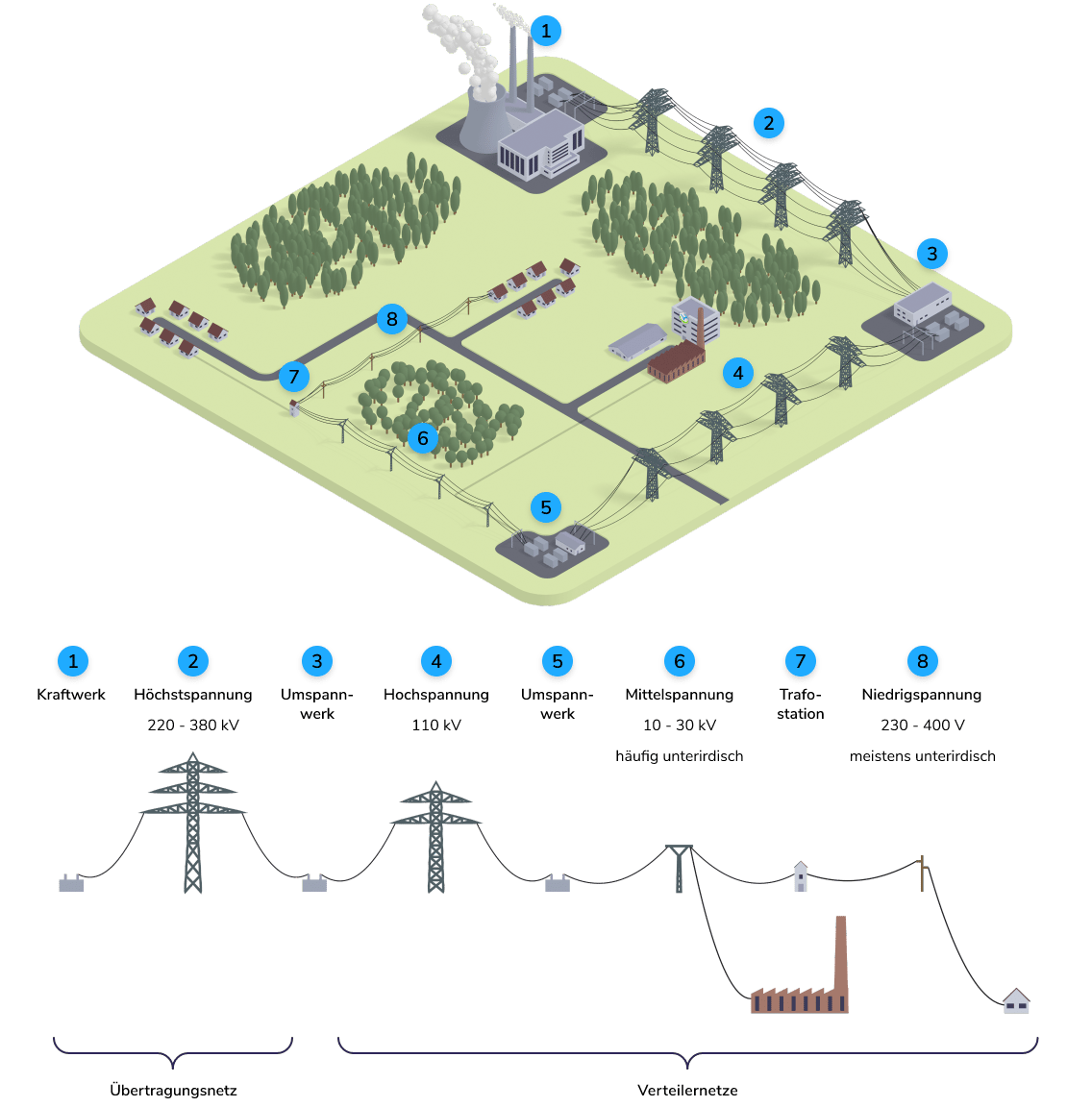
The reconstruction planning of transmission system operators like TransnetBW is responsible for the strategic planning and implementation of measures to modernize and expand the power grid, to enable the energy transition and ensure security of supply. This planning is a multi-stage process, ranging from needs assessment through route planning to approval and implementation.
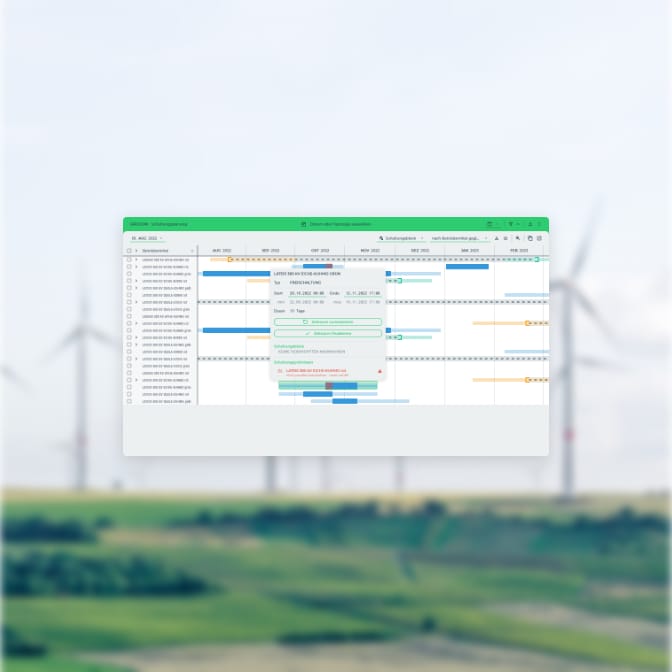
In concrete terms, this means careful coordination of so-called switchings over a long-term period. These describe the temporary shutdown (days to months) of operating equipment such as transformers, busbars in substations, or entire overhead lines. Switchings are organized in projects and sub-projects. Examples include maintenance work that takes place simultaneously with connecting a north-south route or a wind farm. Switchings are also subject to rules (so-called premises) that stipulate that only a limited number may be switched off within a network of operating equipment. This goes so far that switchings must be connected in parallel, in series, or not in series. For example, a premise might be that a switching may only take place in winter or during the summer holidays. All these elements and their relationships are summarized in a switching calendar.
The previous static solutions for reconstruction planning are reaching their limits due to various factors:
The following shows an exemplary switching calendar after data import. To create a compromise between the multitude of settings and functions and a clear interface, users can show and hide menus as needed. Care was taken to group functions sensibly or explain them through tooltips for high user-friendliness.
This allows the desired data sets to be displayed quickly and clearly in just a few steps. The result enables smooth editing of a switching calendar.
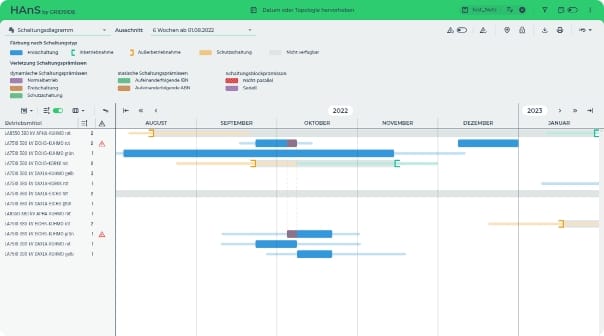
A: Display with multiple menus: filter, legend, row height, color scheme
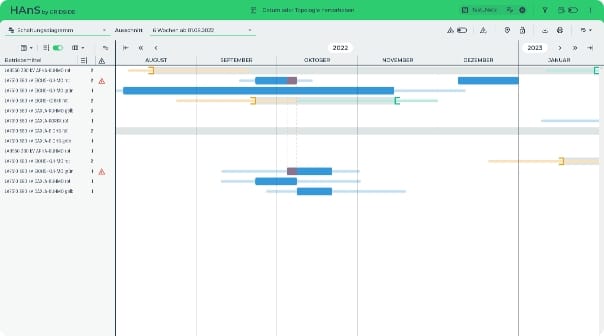
B: Minimal display for better working
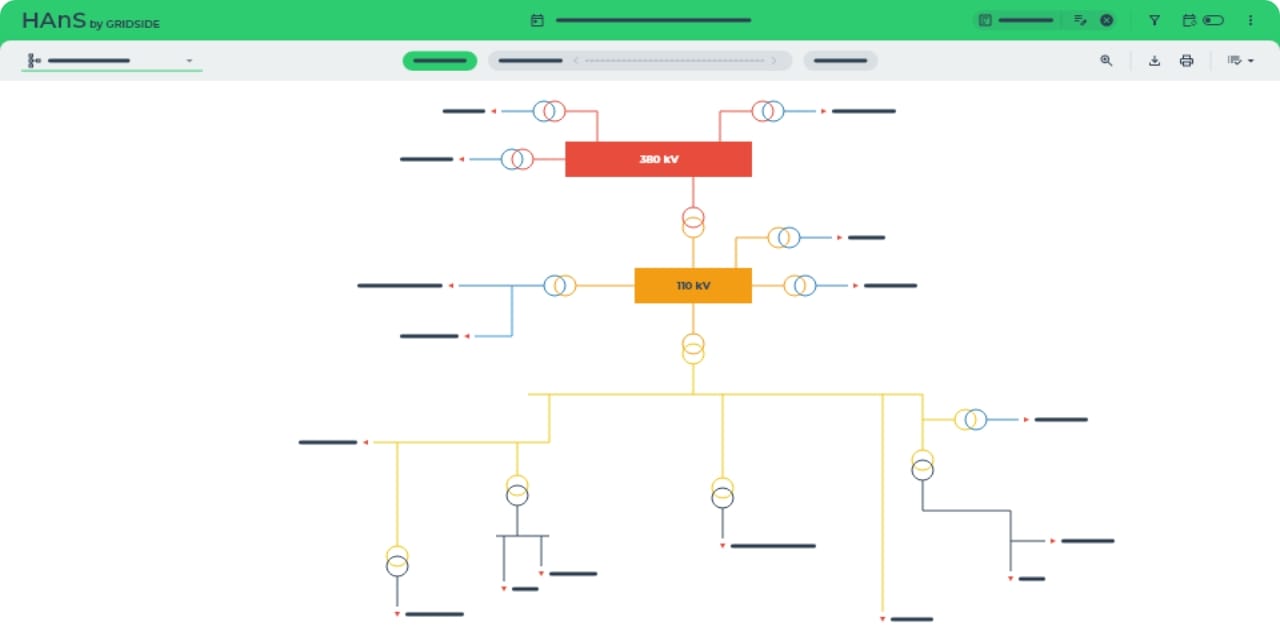
Network plan with displayed legend. Topologies can be traversed in a timeline to highlight switchings on operating equipment in color
As evident from the previous explanations, the particular challenge of the project was the technical immersion into the complex domain of power grid management. Our team had to develop a deep understanding of the reconstruction planning processes while creating a solution that can flexibly handle a variable number of operating equipment and their complex dependencies. But this is exactly where our strength lies: At Helm & Walter, we distinguish ourselves through our ability to dive deep into our clients' application areas.
The result? Digitization at the highest level that excites! The intuitive user interface ensures a smooth workflow and allows new colleagues to get up to speed significantly faster. What used to take days now takes just a few hours – an enormous efficiency gain for the entire team.
Toni Derlig, Senior Engineer Dynamics, GRIDSIDE Energy Consult GmbH
Particularly gratifying: The software is continuously being expanded through internal requests from various departments. The original scope of functions is growing organically with the needs of the users. External service providers like GRIDSIDE, who work closely with TransnetBW, also benefit enormously from the new solution. The collaboration between TransnetBW, GRIDSIDE, and our team is extraordinarily productive and is a prime example of successful digitization in the energy industry.
And we're not resting on our laurels: The next milestone is already on the agenda for this year: the implementation of comprehensive report creation with just one click. This will significantly increase the efficiency of planning once again and optimally support TransnetBW in their important task of the energy transition.

The UI/UX design focuses on a clear structure and consistent user experience when displaying complex data. Interactive visualizations such as Gantt charts, network diagrams, and tabular overviews enable intuitive comprehension of even extensive planning processes with clear presentation and highlighting of planning conflicts. An independent design system ensures uniform design principles and supports the continuous development of the application while also being available for other applications. Through the iterative use of high-fidelity prototypes and regular feedback loops, a modern, responsive user interface was created that combines functionality, overview, and an appealing, modern design.

To ensure the highest security standards, a single sign-on solution was implemented. This provides authorized users with convenient, centrally managed access – without separate logins. This integration fulfills strict compliance requirements while simultaneously supporting the cloud strategy of companies with critical infrastructure.